
What Garfield County Property Tax Records Show
Two offices split the work. The Assessor values taxable real property and applies any exemption, while the Treasurer mails notices and collects current and prior-year taxes. The public pages describe those duties clearly. What they lack is a full county bill-search result or a complete parcel-card field list, so the table works best as a source map. Before quoting any amount, confirm the year, the office, and whether the figure is a value, a taxable base, a charge, a balance, or a payment.
| Field | What It Shows | Where |
|---|---|---|
| Fair-market value | Assessor’s value as of the assessment date | Assessor |
| Taxable value | Value after an applicable exemption | Assessor |
| Exemption type | Tax status applied to the parcel, if eligible | Assessor |
| Tax charge and payment | Current or prior-year amount collected and payment applied | Treasurer |
| Tax district | Jurisdiction used to explain local charges | Assessor / Treasurer |
Utah starts residential valuation at fair market value, not the amount due. A qualifying primary residence generally gets a 45 percent exemption, leaving 55 percent taxable. Local rates and charges produce the tax due later on. A sale is simply an event on a date. The deed may show consideration. The assessor value describes the tax roll. For number meanings and source comparisons, see the Garfield County property value page.
Assessor Value and Treasurer Charges Differ
A Garfield County assessment record starts with the parcel and its value. A Treasurer record starts with the notice and the payment. The county lists online payment and autopay. But the public Treasurer page publishes no tax-bill lookup form, delinquent list, or tax-sale archive. A payment portal is a payment route, not an owner or bill search. When the notice is missing, call the Treasurer with the parcel or account number. Ask which current and prior-year figures exist.
For value, parcel details, exemptions, and mailing fields, the Assessor is the better source. For the bill, balance, and payment date, go to the Treasurer. Ask how a coupon was applied. A recent deed may not yet appear in the tax roll. A paid bill does not establish title. Each office answers a different part of the same property question.
Utah’s Primary Residence Taxable Share
How does Garfield County tax a home you live in? Utah law sets the starting point. Residential property is assessed at full fair market value each January 1. A qualifying primary residence then gets a 45 percent exemption from the county assessor. That leaves a taxable value of about 55 percent of market value. The tax bill is calculated on that reduced base.
A second home or unoccupied residence does not qualify. It stays taxable at full market value on the county tax roll. One thing the exemption does not touch is the deed. The consideration a buyer pays is recorded in the deed records. That amount reflects the real sale, not the exemption.
| Fair-market value | Assessor’s full-value estimate for the assessment date |
|---|---|
| Primary-residence exemption | Usually 45 percent for a qualifying residence, subject to state rules |
| Taxable value | Ordinarily 55 percent of market value after that exemption |
| Tax due | Later calculation using local rates and charges |
The exemption is not proof that the titled owner occupies the parcel. Keep market value, taxable value, exemption type, and tax due in separate columns.
Garfield County Prepayment Coupons Use a Parcel
The Treasurer offers optional prepayment coupons from February through October. The coupons use the prior year's tax amount. The October notice reconciles them against the actual bill. Always give the parcel number when paying. Staff then apply the money to the right account. If a payment exceeds the tax, the county applies the extra to the next year. The payer can ask for a refund instead.
That process differs from paying the final bill. It differs again from checking whether a tax is delinquent. Save each coupon date and amount. Then compare the October notice with the total already paid. If the parcel was divided or its account changed, confirm the allocation with the Treasurer. Do not assume the old identifier still routes correctly.
Looking Up a Garfield County Tax Bill
The county Treasurer publishes payment options, contact details, and office hours. It posts no public parcel-by-parcel bill-search screen, though. An online payment button is a payment route, not proof of a searchable tax roll. Start from the notice or the parcel identifier. Then ask the Treasurer what balance, payment, or prior-year data the office can provide. The county page sits at Garfield County Treasurer.
- Locate the parcel or account number on a deed, prior notice, or assessor result.
- Contact the Treasurer and ask for the current and prior-year charge, payment dates, and balance.
- Check the Assessor’s parcel record separately for market value, taxable value, and exemption status.
- Ask whether a delinquency or tax-sale record exists; a public online list was not located.
- Fair-market value
- The Assessor’s estimate of full value for the assessment date.
- Taxable value
- The portion used in the later tax calculation after an exemption.
- Tax district
- The taxing jurisdiction associated with the parcel record.
- Tax lien
- A recorded or statutory claim tied to unpaid taxes; verify the specific record with its custodian.
Card and ACH Costs Are Payment Fees
The Treasurer lists a 2.5 percent card processing fee with a $2.50 minimum, and ACH or e-check processing costs 75 cents. Those are transaction costs, separate from the property tax charge itself. Payment works online, by autopay, by phone, by mail, and at the courthouse counter. Check the live payment page before paying, since the processor controls the final checkout amount and method.
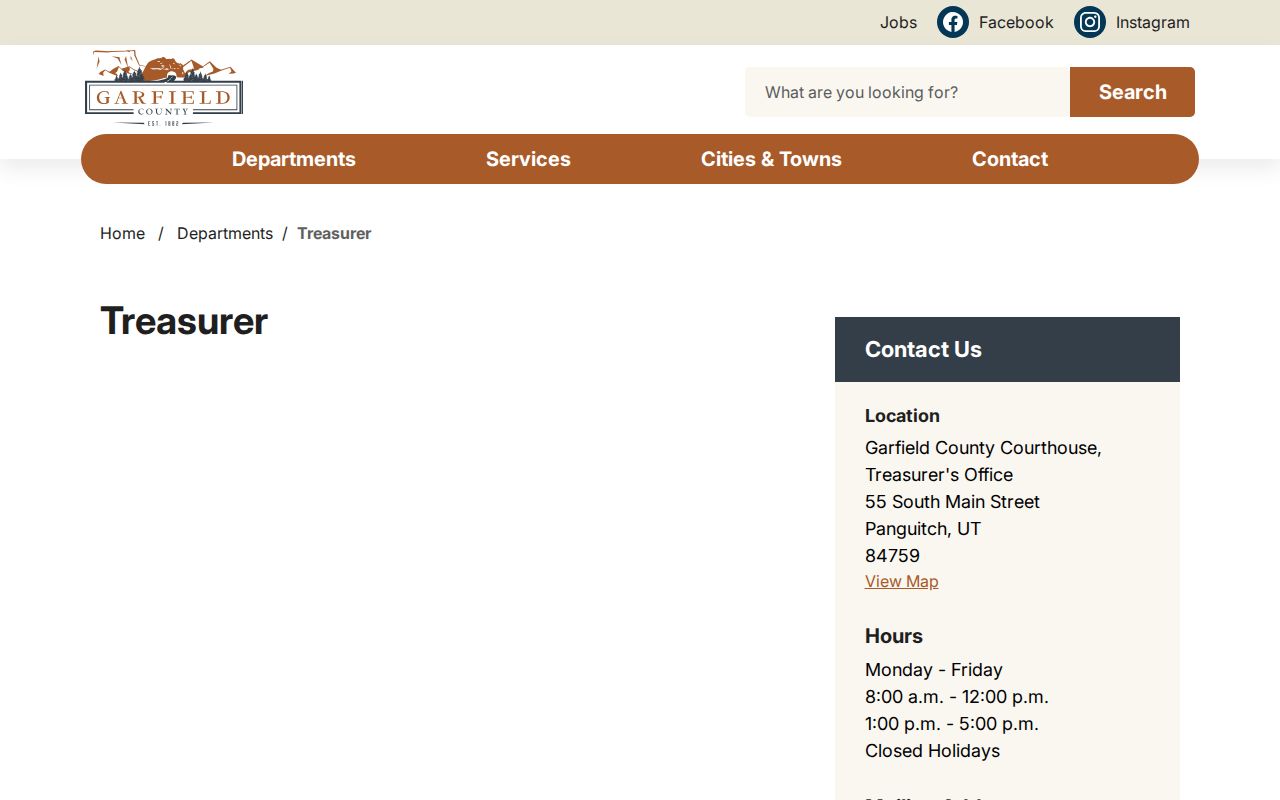
The Treasurer's own page lists the office at 435-676-1109, with counter and mail service at 55 South Main Street or PO Box 77 in Panguitch. Hours run Monday through Friday, 8:00 a.m. to noon and 1:00 to 5:00 p.m. A call helps when a parcel number changed, an excess payment rolled forward, or the notice and the payment record disagree. Open the Treasurer's payment page for the current methods and fees.
Treat the payment page as a route to fee and method details. When the question is a balance, ask the Treasurer for a bill record.
Appeal a Garfield County Value on Time
Garfield County property owners receive a valuation notice by July 22 under Utah's local-assessment schedule. The first appeal goes to the county Board of Equalization. That deadline is generally September 15. Sometimes it shifts to the later of those dates. It may be 45 days after the notice mailing date instead. The individual notice controls the deadline for your parcel. Keep the envelope, notice date, parcel ID, proposed value, and submitted evidence in one file.
Evidence works best when it speaks to value. Comparable sales help. So do dated photographs, condition details, a factual correction, or an appraisal. A win this year does not carry forward automatically. If the county board rules against you, appeal to the Utah State Tax Commission within 30 days. The state names form TC-194 for locally assessed property. The state lists the Garfield County Board of Equalization at 435-676-1100.
The Utah locally assessed property appeal process page lays out the steps. The state's appeal guide does the same.
Request a Garfield County Tax Record Under GRAMA
Some records never make it online. A tax bill, payment ledger, prior-year notice, or exemption record may require a written request to the office that holds it. In Garfield County, the Treasurer keeps charges, receipts, payment dates, and balances. The Assessor keeps parcel valuation and exemption fields. Name the parcel or account number, tax year, and the record you want. If a parcel split or ownership transfer changed the account, explain that history. Cite the deed reference when you have it.
Utah's Government Records Access and Management Act governs the response process. A standard request is answered within 10 business days. An expedited one gets five business days when it meets the legal criteria. A fast response is not a guarantee that every record arrives at once. Agencies may charge reasonable search and copy fees. So ask the custodian about cost before requesting a large ledger or a historical batch. Remember, a GRAMA request reaches existing records only. No office must build a new tax analysis or explanation for you.
Appealing a Garfield County Assessment
The Board of Equalization weighs one question. Is the Assessor's fair-market figure, or the owner's proposed value, more representative? Build your case around the parcel's condition and its market on the assessment date. A map, comparable sale, photograph, or corrected building fact carries the most weight. Tie each item to the parcel ID and year. Simply calling the taxes high proves nothing about value.
Appeal window. The county appeal is generally due by September 15 or 45 days after the notice is mailed, whichever is later. Follow the date on the parcel’s notice and use the county Board of Equalization first.