
What Garfield County Deed Records Establish
The Recorder's index holds more than one kind of conveyance. A deed moves an interest from a grantor to a grantee. The type of deed shapes what that transfer promises. A warranty deed, quitclaim deed, tax deed, and trustee deed are not equal commitments. Garfield County also indexes straight deeds of conveyance and quitclaim water-right deeds. Read the instrument itself to learn the parties and the property description. It also shows the execution details and any stated consideration.
| Deed Type | What It Does | Common Use |
|---|---|---|
| Warranty deed | Conveys the described interest with stated warranty terms | Ordinary property transfer |
| Quitclaim deed | Transfers whatever interest the grantor holds, if any | Family or title-interest change |
| Tax deed | Records a transfer following a tax process | Tax-related conveyance |
| Trustee’s deed | Records a transfer by a trustee under the instrument | Trust or trustee transaction |
| Water-right deed | Records a stated water-right interest | Separate water documentation; Recorder does not search the right |
Not every filing transfers ownership. A mortgage or deed of trust secures a debt. An assignment shifts who holds an interest. A release, satisfaction, or reconveyance shows a security interest was discharged. A notice of default alone does not prove a foreclosure ever finished. Garfield County records deeds alongside these other instruments. The document type and legal description matter just as much as the party name.
The Garfield County Index Starts in 1882
The official Recorder page states that the cross-referenced index reaches back to 1882. That is the year Garfield County was founded. That date marks index depth, not the start of digitized images. The county says instruments and maps are open for public inspection. Recorded documents are not currently online. The Recorder’s page is the live source for hours, contacts, copy methods, and fee notices.
For a remote property, an ownership plat kept for assessment work can help staff pinpoint the parcel. They can then work through the name index. Ask the office to run both grantor and grantee sides. This matters most when a name changed. It also matters when a transfer ran through an estate or entity. The Recorder does not perform title searches. The Recorder does not interpret deeds, draft legal descriptions, or search water and mineral rights. A searcher has to spot the instruments and read them in order.
Note: An index reaching 1882 does not mean every earlier chain ends there. Another record group may be needed.
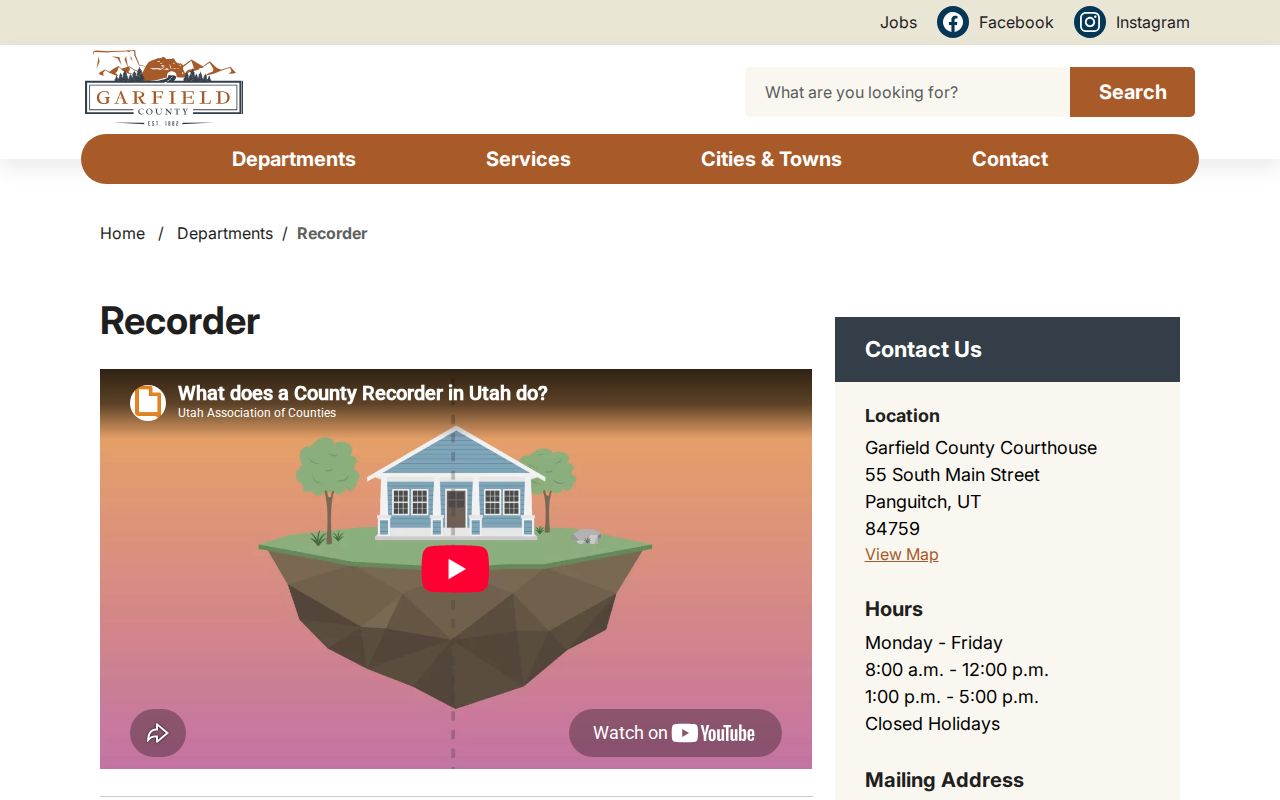
The image shows the office’s own access statement rather than a deed image or a grantor-grantee result.
Copying Garfield County Deed Records
Copies of recorded deeds carry set charges. Garfield County lists $1 for the first page. Each added page costs 50 cents. A certification charge also applies. The Recorder page does not state the amount, so confirm it before ordering a certified copy. Xerox sheets, large-format maps, ownership plats, survey plats, mailed information, and ownership-listing reports each carry their own prices. A deed request should state plain or certified copies and include the likely page count.
Payment can be cash, check, or credit card, with checks payable to Garfield County. Mailed or emailed information is listed at $4. Do not confuse copy fees with the $45 document recording charge effective May 4, 2026. That fee covers recording a new document, not a requester's copy. If an invoice sits unpaid past 30 days, the county requires pickup in person.
How Garfield County’s Grantor-Grantee Trail Reads
A grantor gives up an interest; a grantee receives it. The chain of title is the ordered run of recorded transfers. It ties past holders to the present owner of record. Garfield County's index is cross-referenced but offers no online search form. Bring a current or prior owner name and the parcel number. Add the subdivision or lot, a date range, and the legal description if you have one.
Begin with the most recent deed you can spot. Read its grantor and grantee. Then treat the grantor as a likely prior owner. Find the deed through which that party took the parcel. Compare the legal description at every step. A shared name can merge two unrelated people or two tracts. Parent parcels split into lots. A trustee, estate, or tax deed can explain a sudden jump in names. The instrument, never the index label, is the link worth verifying.
- Ask the Recorder to locate the latest transfer using the current grantee, parcel, description, and approximate date.
- Write down its grantor, grantee, type, recording date, and book/page or instrument reference.
- Search the prior grantee’s name as an earlier grantee and compare the legal description.
- Continue until the desired period or record series changes, then ask for older volumes or archive guidance.
- Grantor
- The party named as giving or transferring the stated interest.
- Grantee
- The party named as receiving that interest.
- Chain of title
- The sequence of instruments used to trace ownership backward or forward.
- Index reference
- A book/page or other filing reference that points staff to a recorded document.
Garfield County Records Include Water and Mining Filings
Water and mining filings sit in the Garfield County Recorder's books. They appear right beside ordinary home sales. The office records water documents, quitclaim water-right deeds, notices of locations, proofs of labor, and patented mining claims. Subdivision, district, annexation, and roadway dedication plats are recorded there too. Garfield County holds ranches, remote tracts, and public land next to private parcels. There, these property records matter as much as any deed.
One limit deserves note. The Recorder does not search mineral or water rights. The office states this plainly. A deed index result can point you to an instrument. Yet it is no substitute for a substantive review of those interests. Find out which agency or index holds the separate water or mineral record before you lean on the land chain. For a boundary change, request both the recorded plat and any related annexation ordinance. One gives the map while the other explains the legal action.
Property Watch Tracks New Garfield County Filings
The Garfield County Recorder offers Property Watch. It is a free service for residents who hold title to a parcel. When a new document is recorded, the service sends an automated email alert. Contact information stays protected and is used only for the alerts, the county says. Register a parcel you own and watch for new activity. Just treat the alert as a courtesy, not a title report.
Not every recorded document attaches to a property. So a missing alert does not prove no filing exists. Keep both the parcel and the name-based trail in view. That matters above all when title sits with a trust, estate, or entity. The Recorder's official page carries the full alert terms and the signup link.
Utah Court Files Can Explain a Deed Event
A recorded deed often has a court case behind it. Foreclosures, quiet-title disputes, partitions, lien cases, and probate matters can each generate a court file. Each can also generate a recorded instrument. Utah Courts Xchange supplies public district and justice court case information. Panguitch coverage begins February 24, 2000. Eligible public electronic filings from July 1, 2010 onward may be purchased. Older converted cases may be incomplete. Private or sealed records are never displayed.
Access costs $10 once for an account, 20 cents per search, and $1 per document. Free public terminals sit at most district courts and the Utah State Law Library. Search by the parties or a known case number. Then confirm any judgment or transfer in the Recorder's land records. A case event and a deed have different custodians, so log them separately. The Utah Courts Xchange access information spells out the public-access rules.
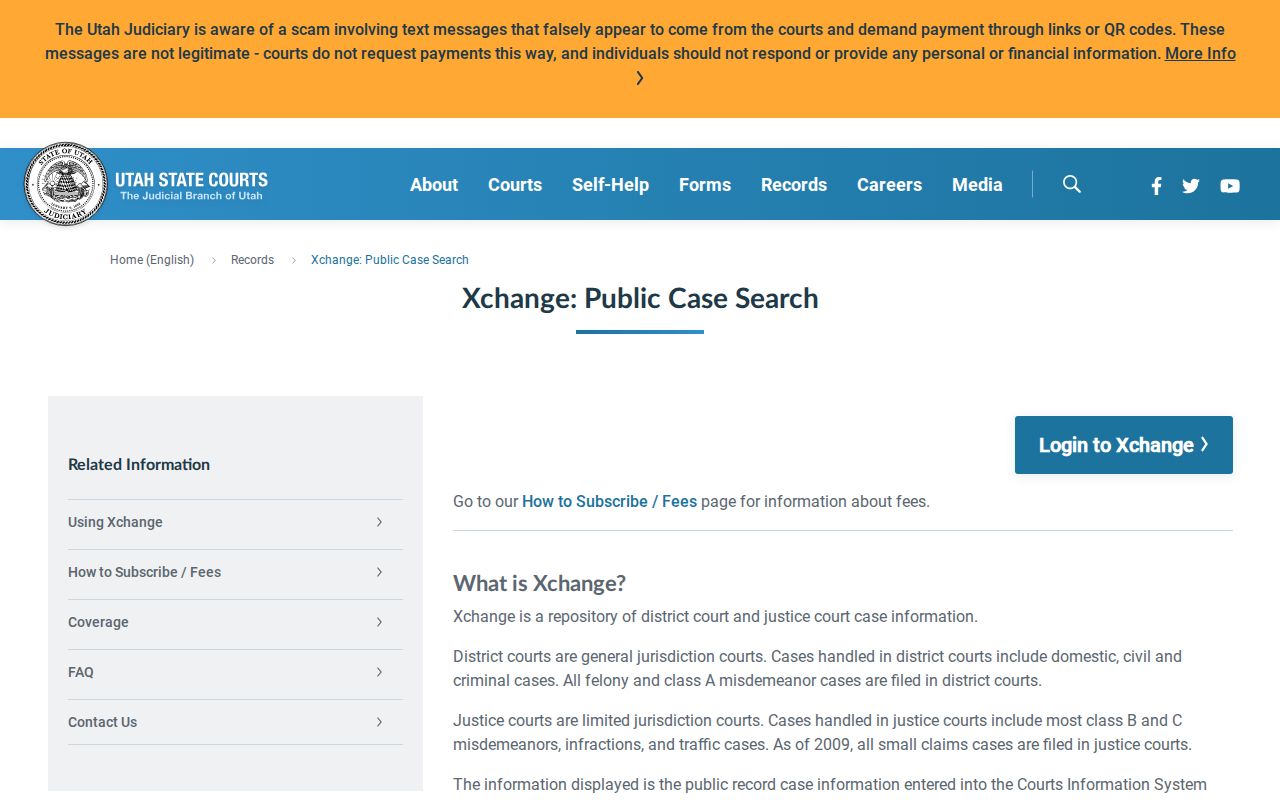
Treat a court result as a lead, not a conclusion. Verify whether a separate deed or lis pendens was recorded before you rely on it.
Older Garfield County Property History Uses Archives
The Garfield County index reaches back to 1882, an unusually deep start. The exact shelf runs for older deed books do not appear in the index itself. The same goes for tax rolls and plats. Utah State Archives fills that gap. It offers an agency record-series lookup covering Garfield Recorder, Assessor, Treasurer, Surveyor, Clerk, Probate Court, and Board of Equalization collections. Search the catalog for series, dates, and access notes. Do not assume a volume waits at the courthouse or online.
The Archives has digitized Garfield County Clerk birth registers from 1898 to 1905. Current land instruments stay counter-oriented. Each series needs its own access check. For a city-block history, compare the deed description to a recorded plat. For a remote tract, preserve the section-township-range and metes-and-bounds calls. Index depth marks a starting boundary, not proof the full history is in hand. For the backward chain itself, continue to the Garfield County former-owners record route.
Getting a Copy of a Garfield County Deed
No public online recorder index offers Garfield County deed images. Plan on counter inspection, or a request by mail or email. The Recorder sits at 55 South Main Street. The office is in Panguitch, open Monday through Friday from 8:00 a.m. to noon and 1:00 to 5:00 p.m., except holidays. Call the Recorder at 435-676-1110 or the deputy at 435-676-1112. Give staff the most specific identifiers you have. Ask whether it can be sent or picked up.
Fees stay modest. A first-page deed copy is listed at $1. Later pages run 50 cents. A certified copy may carry an added charge the county page does not state. Survey plats, ownership plats, and large map sheets run under other rates. Verify the current fee before sending payment. Ask whether staff can locate the document from your parcel information. Read the deed itself for its legal description and parties before drawing any chain-of-title conclusion.
Recorded, not guaranteed. The Garfield County index points to documents that were recorded; it is not a title opinion, and unrecorded interests may exist. A title professional reviews the chain and other evidence before stating whether ownership is clear.